 Español
  English
  Français
  Deutsch
 Toy Poodle
The Toy Poodle is one of the most intelligent and adaptable breeds in the world. Hypoallergenic, playful and deeply affectionate, it is the ideal companion for families, seniors and urban lifestyles.
1 puppy available

1 puppy available
Technical sheet
Ratings
Available now
Puppies looking for a home
All our puppies are dewormed, vaccinated and ready to fill your home with joy.
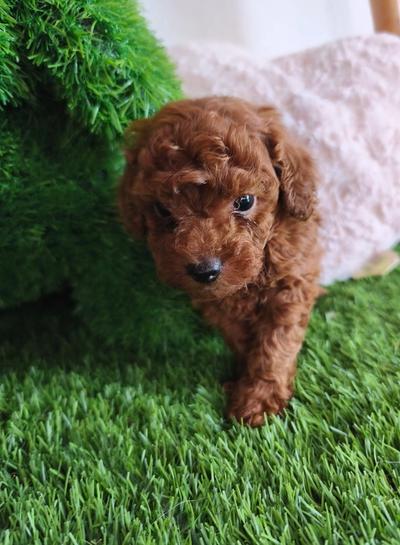
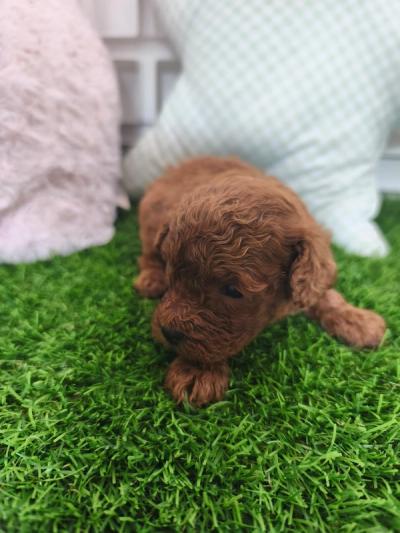
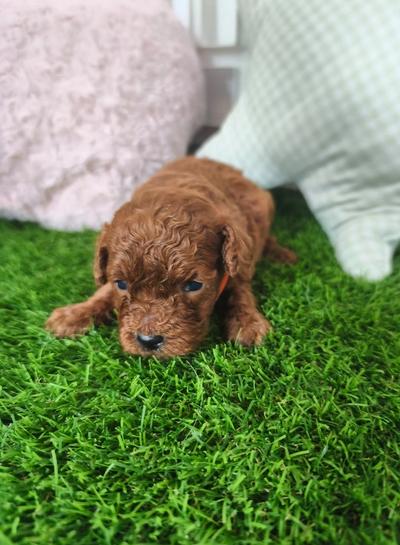
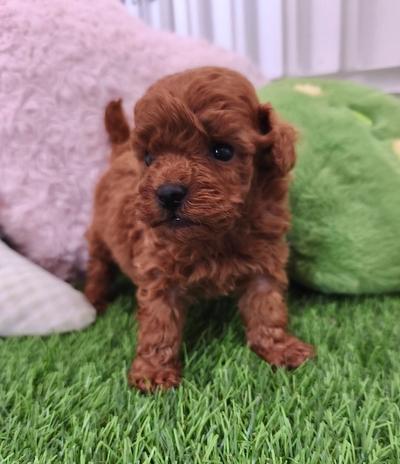
Temperament
The Toy Poodle is a breed renowned for its intelligence — it consistently ranks among the top positions in canine intelligence rankings — and for its balanced temperament. It is cheerful, active and extraordinarily receptive to training, with a learning ability that makes it the ideal companion for first-time dog owners. It bonds strongly with its family and does not cope well with prolonged solitude. It displays a sociable character with people and other animals when socialised from puppyhood. It is a breed well suited to families with children, seniors and urban living, thanks to its combination of small size, low-shedding coat and intense emotional bond.
Care
The Toy Poodle has curly, continuously growing hair with no visible seasonal shedding, which means it requires professional grooming every six to eight weeks to maintain the length and prevent mats. At home it should be brushed two to three times a week with a long-pin brush and metal comb, paying special attention to the ears, armpits and groin — the areas most prone to matting. Bathing is done every three to four weeks with a shampoo formulated for curly hair. The ears, with their drooping pinna and hair in the ear canal, should be checked weekly. Nails are trimmed every three to four weeks. At our kennel in Dénia we accustom puppies to brushing, the grooming table and the sound of the dryer from five weeks of age, which reduces stress during their first visits to the professional groomer.
Adult size
The FCI recognises four Poodle varieties (Caniche, Group 9) classified by size: standard, medium, miniature and toy. The Toy Poodle is the smallest variety, with a height at the withers of between 24 and 28 cm and an approximate adult weight of 2 to 4 kg. It is distinguished from the miniature by its shorter height and lighter build, while always maintaining the correct breed proportions (never a forced miniaturisation). Recognised colours are black, white, brown, grey and fawn; the standard requires a uniform coat without patches.
Family life
It fits very well with families with children, provided they are taught not to pick it up roughly. It coexists without issue with other dogs and cats, especially if socialised from puppyhood. It is an ideal breed for flat living due to its size, low shedding and moderate activity level, although it needs two to three daily walks combined with mental stimulation (scent games, basic obedience, tricks) to maintain its balance. We serve families in Dénia, Valencia, Alicante, Benidorm and Murcia, many of them in flats or urban townhouses. It is advisable to work on alone-time tolerance from puppyhood to prevent separation anxiety, to which the breed is especially prone.
History and origin
The Poodle's origin lies in central Europe, probably Germany (from the German Pudel, "to splash"), as a water retriever. France adopted and refined the breed, making it the national breed from the 17th century onwards, and since then the French FCI maintains the official standard. The toy variety was established in the 20th century through selection from the miniature variety, preserving proportions and character. The FCI classifies it in Group 9 — Companion dogs, section 2 — Poodle. It is one of the most widespread breeds in the world thanks to its combination of intelligence, sociability and adaptability to urban life.
Nutrition
A high-quality kibble formulated for toy breeds is recommended, with animal protein as the first ingredient and small kibble size. Puppies eat three to four times daily until six months of age; adults eat twice a day. The Toy Poodle is prone to hypoglycaemia as a puppy and to obesity as an adult, so portions are weighed and treats are limited. Table scraps and bones that could splinter should be avoided. Fresh water should always be available, with special attention in summer in the Mediterranean climate.
Breed-specific health
The conditions most commonly associated with the breed are progressive retinal atrophy (PRA), patellar luxation, Legg-Calvé-Perthes disease and dental problems. To reduce risks we work with parent lines that have been genetically tested for PRA, schedule annual ophthalmological and orthopaedic check-ups, and recommend dental brushing from puppyhood. Each puppy is delivered with an official veterinary booklet, microchip, vaccinations and deworming up to date, and a breed-specific initial assessment of patellae and eyes. Full details of our health protocol and guarantees can be found on the relevant page of this site.
Fotos del Toy Poodle próximamente
Mientras tanto, escríbenos y te enviamos fotos por WhatsApp.
Ver fotos por WhatsAppFrequently asked questions
Everything you need to know
6 questions answered
More questions? Write to us- Is the Toy Poodle hypoallergenic?
-
The Toy Poodle is considered one of the most recommended breeds for people with a mild allergy to dog hair or dander, as it does not present visible seasonal shedding. No breed is completely hypoallergenic: there is always the presence of dander and saliva. If there is a confirmed allergy in the household, we recommend a trial cohabitation period before booking to validate individual tolerance.
- Is the Toy Poodle good with children?
-
Yes. The Toy Poodle is one of the most balanced breeds for living with children due to its patient temperament, intelligence and willingness to learn. We recommend cohabitation with children from five years of age onwards, who are able to understand that the dog should not be picked up roughly. At our kennel in Dénia, we socialise the puppy with noise and child interaction from the third week to facilitate adaptation.
- How long does a Toy Poodle live?
-
The Toy Poodle has a life expectancy of between 14 and 17 years, one of the longest among toy breeds. The genetics of the parents, weight management, dental health and regular eye check-ups are the factors that most influence their longevity. A Toy Poodle at a healthy weight with a proper health protocol frequently surpasses 15 years.
- What grooming does a Toy Poodle need?
-
The Toy Poodle needs professional grooming every eight to ten weeks to maintain coat length and prevent matting. Between visits, brush two or three times a week at home with a long-pin brush and a metal comb. The most common cuts are the puppy cut (uniform) and the modern cut (short body, rounded head). We accustom the puppy to handling from the kennel to reduce stress at the groomer.
- Is the Toy Poodle suitable for apartment living?
-
Yes. The Toy Poodle adapts very well to apartment living due to its small size, low shedding and moderate activity level. It needs two or three daily walks combined with mental stimulation (obedience, tricks, scent games) to maintain its balance. It is important to work on tolerance to time alone from puppyhood, as this is a breed particularly sensitive to separation anxiety.
- Where to buy a Toy Poodle in Dénia?
-
At our kennel in Dénia, an officially registered breeding facility with selective breeding of Toy Poodles within the FCI standard. Interested families can arrange a visit via WhatsApp to meet the puppy and its parents before booking. We also serve families from Valencia, Alicante, Benidorm and Murcia, and coordinate delivery under the conditions that best ensure the puppy's welfare.
01
02
03
04
05
06
Service areas
Where we deliver Toy Poodle puppies

Your new best friend is waiting
Browse our available puppies or message us on WhatsApp. We help you find the perfect companion for your family.
We respond within 24 hours ·
No obligation