 Español
  English
  Français
  Deutsch
 Smooth Miniature and Kaninchen Dachshund
The Dachshund, with its unmistakable elongated silhouette, is a brave, curious and deeply loyal dog. It adapts well to flat living and forms an inseparable bond with its family.
1 puppy available
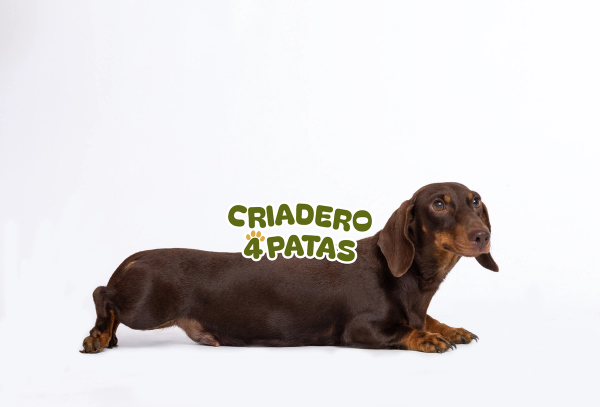
1 puppy available
Technical sheet
Ratings
Available now
Puppies looking for a home
All our puppies are dewormed, vaccinated and ready to fill your home with joy.
Sizes
Miniature and Kaninchen: what is the difference?
The FCI and the RSCE (Spanish Kennel Club) classify dachshunds by chest circumference, measured from 15 months of age, not by weight. At 4Patas we breed the two smaller sizes of the breed.
Kaninchen
Chest circumference up to 30 cmThe smallest size of the breed. A favourite for apartment living and travelling with the family.
Miniature
Chest circumference over 30 cm up to 35 cmSlightly sturdier than the Kaninchen, with the same brave and affectionate dachshund character.
Chest circumference is measured from 15 months of age.
The standard dachshund exceeds 35 cm chest circumference; we do not breed it.
Coat and colours
Short coat: chocolate and chocolate dapple
At 4Patas we only breed smooth (short-haired) dachshunds, in both the Miniature and Kaninchen sizes.
Chocolate
A deep, even brown, with the short glossy coat typical of the smooth variety.
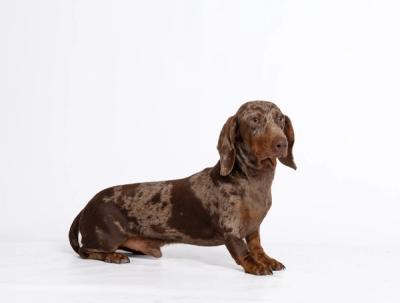
Chocolate dapple (merle)
The merle pattern on a chocolate base, with lighter, mottled patches. The FCI standard calls it "dapple" (tigered).
The short coat is easy to look after: a weekly brush with a rubber glove, an occasional bath and a check of ears and nails. No grooming parlour needed.
As a general rule of responsible breeding, mating two merle dogs (merle x merle) is not recommended because of the risk of deafness and eye problems in the puppies. A merle dog with a single merle parent is compatible with a healthy dog.
Temperament
The Dachshund is an independent and lively breed with a marked hunting instinct inherited from its origin as a burrow dog. Despite its small size, it behaves like a big dog: brave, alert and very attached to its family. It gets along well with older children who understand its particular anatomy and accepts other dogs without issue if socialised from puppyhood. It is a breed suited to active families and also to seniors seeking an affectionate and alert companion, provided its need for daily walks is respected. Its vocal tone is distinctive: the Dachshund barks to alert, not out of anxiety.
Care
The smooth (short-haired) Dachshund is easy to care for: a weekly brush with a rubber glove is enough, with an occasional bath and no grooming parlour or stripping. Ears should be checked regularly and nails trimmed every three to four weeks. Exercise should be moderate and without abrupt jumps from sofas or stairs to protect the spine. At our kennel in Dénia we accustom puppies to brushing, ear and nail handling, and the lead from five weeks of age, so they arrive home with basic care routines already established.
Adult size
The FCI and the RSCE classify the Dachshund by chest circumference, measured from fifteen months of age, not by weight. We breed two varieties. The kaninchen (rabbit) is the smallest, with a chest circumference of up to 30 cm. The miniature has a chest circumference of more than 30 cm and up to 35 cm. Above 35 cm the Dachshund is considered standard size, and we do not breed that variety. Body length always takes precedence over height: the Dachshund keeps its characteristic elongated silhouette in every variety.
Family life
It gets along well with families with children over six years old, provided they are taught not to pick it up and to respect its back. It gets on well with other dogs and can live with cats if introduced from puppyhood. It is a breed suited to flat living thanks to its size, on the condition that repetitive stair climbing and jumps from height are avoided. We serve families in Dénia, Valencia, Alicante, Benidorm and Murcia, and many of them live in flats without any issues. The Dachshund needs companionship and does not cope well with being left alone for many hours: if no one is home during the day, it is worth considering another option.
History and origin
The Dachshund is a German breed whose name comes from Dachs (badger) and Hund (dog). It was developed in 16th-century Germany to hunt badgers inside their burrows, taking advantage of its low, elongated silhouette and brave temperament. The FCI classifies it in Group 4 — Dachshunds, a group exclusive to the breed, and distinguishes three sizes and three coat varieties (smooth, wire-haired and long-haired), giving a total of nine recognised combinations. The official standard is maintained by the Deutscher Teckelklub. At 4Patas we breed only the smooth (short-haired) variety, in miniature and kaninchen sizes, in chocolate and chocolate dapple (merle).
Nutrition
A quality kibble formulated for small or medium breeds is recommended, with animal protein as the first ingredient. Puppies eat three to four times a day until six months of age; adults eat twice a day. Weight management is especially critical in this breed: excess weight directly increases the risk of back problems. Excessive treats, table scraps and bones that could splinter should be avoided.
Breed-specific health
The condition most commonly associated with the Dachshund is intervertebral disc disease (IVDD), resulting from its elongated spine. To reduce the risk it is advisable to maintain a lean weight, avoid jumps from height, limit stair use during growth, and use a harness instead of a collar on daily walks. Other recommended check-ups include ophthalmological examination and periodic hearing assessment. Puppies are delivered with vaccinations and deworming up to date, an official veterinary booklet and health certificate — full details of our protocol can be found on the guarantees page.
Fotos del Dachshund próximamente
Mientras tanto, escríbenos y te enviamos fotos por WhatsApp.
Ver fotos por WhatsAppFrequently asked questions
Everything you need to know
8 questions answered
More questions? Write to us- Is the Dachshund suitable for apartment living?
-
Yes. The Dachshund adapts well to apartment living due to its size and moderate activity level. It needs two or three daily walks to burn energy and relieve itself. It is important to avoid repeated use of stairs and jumping onto the sofa without a ramp, especially during the first year of life, to protect its spine.
- What health checks do you perform on the puppy?
-
Every puppy leaves the kennel with vaccinations and deworming up to date, an official veterinary booklet, microchip and a health certificate issued by a registered veterinarian. Full details of our health protocol and guarantees can be found on the /garantias/ page.
- How long does a Dachshund live?
-
The Dachshund has a life expectancy of between 12 and 16 years, above the canine average. Genetics, weight management and back care are the three factors that most influence their longevity. A Dachshund at a healthy weight with annual veterinary check-ups and moderate exercise easily reaches 14 years.
- Is the Dachshund good with children?
-
Yes, as long as children understand its anatomy. We recommend cohabitation with children from six years of age onwards, who are able to understand that the dog should not be carried in their arms or allowed to jump from height. At our kennel in Dénia, we socialise the puppy from the third week, which facilitates adaptation to the home.
- Where to buy a Dachshund in Dénia?
-
At our kennel in Dénia, an officially registered breeding facility with selective breeding of Dachshunds. Interested families can arrange a visit via WhatsApp to meet the puppy and its parents before booking. We also serve families from Valencia, Alicante, Benidorm and Murcia, and coordinate delivery under the conditions that best ensure the puppy's welfare.
- What is the difference between the Miniature and the Kaninchen Dachshund?
-
They differ only in chest circumference, which the FCI and the RSCE measure from 15 months of age: the Kaninchen is up to 30 cm and the Miniature is over 30 cm up to 35 cm. We breed both sizes; we do not breed the standard dachshund.
- Is the dapple (chocolate merle) Dachshund healthy?
-
Yes, the single merle pattern (only one merle parent) is compatible with a healthy dog. What is discouraged is mating two merle dogs together (merle x merle) because of the risk of deafness and eye problems. It is always worth asking for information about the puppy’s parents.
- What coat do your Dachshunds have?
-
All our Dachshunds are smooth (short-haired). We do not breed wire-haired or long-haired dachshunds. The colours are chocolate and chocolate dapple (merle).
01
02
03
04
05
06
07
08
Service areas
Where we deliver Dachshund puppies

Your new best friend is waiting
Browse our available puppies or message us on WhatsApp. We help you find the perfect companion for your family.
We respond within 24 hours ·
No obligation